


ICE. CAR. RAGE. is a timely tribute to Jess Curtis’ potent legacy

ICE. CAR. RAGE. remounts a landmark work from the San Francisco experimental dance scene, Jess Curtis/Gravity’s 1999 work, Ice Car Cage. In that piece, dancers Jess Curtis, Keith Hennessy, and Jules Beckman performed with the same elements which structure the 2026 work; an enormous block of ice, a car operating under its own power, and a gilded cage. In their original context, these elements served as a cri-de-couer; the ice, a blistering statement on frigid threat of seroconversion, or of homophobia, or both; the driverless car, a manifesto on the deindustrialization of San Francisco–the original work was staged among the vacant lots left behind as port traffic and manufacturing fled the SF waterfront–and the cage, a wry comment on the queer, liberatory possibilities of submission (that is, kink.)
As part of PLEASE. STAY. TOUCH, a retrospective of Jess Curtis’ work in avant-garde dance some 2 years after his death, this remount reintroduces these elements into a deeply changed San Francisco; an SF where, in many ways, the bastards have won. Performers Styles Alexander, jose e. abad, and Clarissa Rivera Dyas tangle with these symbols again–a melting block of ice, a driverless car, a cage–in a moment when these elements have acquired deeply disturbing resonances. The block of ice; a doomed glacier, an American gestapo. A driverless car–the embrace between capitalist speculation and AI on our streets, a weapon of homophobic slaughter, an alibi for state murder. A cage (now hidden and insulated by layers of fabric)–well, a cage.
ICE. CAR. RAGE. asks the audience, now that the masks are off (!)—and especially for those of us who’ve had the privilege to believe in the comforting fictions of decency and meritocracy that have duped us for so long—what the fuck are we going to do about it?
Rage? Perhaps not. The predominant energy behind this transformed work is neither anger nor fury but deep exhaustion. Like the original, this piece is at its most compelling when the performers press themselves to do the impossible; to press their body into a giant block of ice in 50-degree weather, to accomplish (stunning, dangerous) lifts and poses on top of a moving vehicle, or, as Styles Alexander accomplished in one compelling passage, to push a reluctant hatchback a quarter mile across the Fort Mason parking lot, the sweaty effort of this gesture pouring out of him, making his breath ragged and harsh.
The Neofuturists call these moments task-based performance, in which the true stakes of the event and its proximity to real failure give a performance an real, urgent quality. We see this in recordings of Ice Car Cage, where Curtis, Hennessy, and Beckman throw their bodies across the hood of a speeding car, sliding and launching off of it with palpable danger and lack of concern for their own physical safety, giving the car their weight, rolling over its chassis gracefully, fluidly, rapidly, like so much rain over a freshly waxed body panel.
Splayed across the far wall of the parking lot and displayed in the firehouse next door, video projections of this original performance grab me with their mix of unapologetic weirdness, transparent danger, and raw beauty. I marvel at the daring, nerve, and grace of these artists as they danced furiously on the edge of a knife.
We are now nearly thirty years on, and we are still throwing our bodies up against the windmills of our time. But damn, we’re tired. The car itself seems tired too, making lazy loops around the parking lot somewhere between a creep and a crawl. The task-based dramaturgy that once electrified Curtis’ original piece now exhausts us. ICE. CAR. RAGE., is then a picture of a creative scene that has been ground down through three decades of continued disinvestment, gentrification, and myriad climate and civil rights horrors. This framing is rendered all the more potent through the casting of the remount in which features Black, Asian, queer and trans artists. Like the advance of a glacier (if that happens anymore) the forces that animated Ice Car Cage into frenetic action have continued their grinding assault, and this remount is the reflection of the exhaustion and displacement they are leaving in their wake. As one performer underlines with palpable anger in direct address to the audience, none of the people on stage can really afford to live here in San Francisco anymore; all have either been evicted or pushed out to points further afield.
Rather than feeling fired up for the revolution that will overturn this system, I found myself thinking of a meme which has circulated every New Years Eve for over a decade. A cartoon by Peniel Enchill, it’s an image of a glamorous Black woman leaving the last year behind, along with attendant baggage like negativity, hate, jealousy. One foot poised to climb into the year ahead, her bag is filled with love, focus and peace.
The joke is that every year we see this same image, just with the numbers switched. Rather than being liberated by the New Year, the woman seems to be forever climbing upwards in a Sisyphean hell, where every year she accumulates more awful baggage despite her best efforts, and each coming, exhausting year promises more of the same.
Though I wasn’t liberated by ICE. CAR. RAGE., I did feel something else while sitting on the exposed edge of the city in the freezing SF summer. I felt a real sense of community; between myself, the audience, and the performers in front of me. Perched on a loading dock, my friends and I literally clung to each other, huddling together under blankets and sweaters, trying to insulate ourselves from the cold and damp while clutching paper cups of hot tea. When Clarissa pressed her nearly naked torso against the block of ice during the piece’s final act, a collective gasp rippled through the frigid audience. The gorgeous physicality of her duet with the ice met the visceral discomfort of this task, a brutal sensation that all of us in the audience were powering through. As Clarissa slid her palm, her cheek, and her bare spine down the block, I felt tied to her and to everyone around me. We are all in this shit.
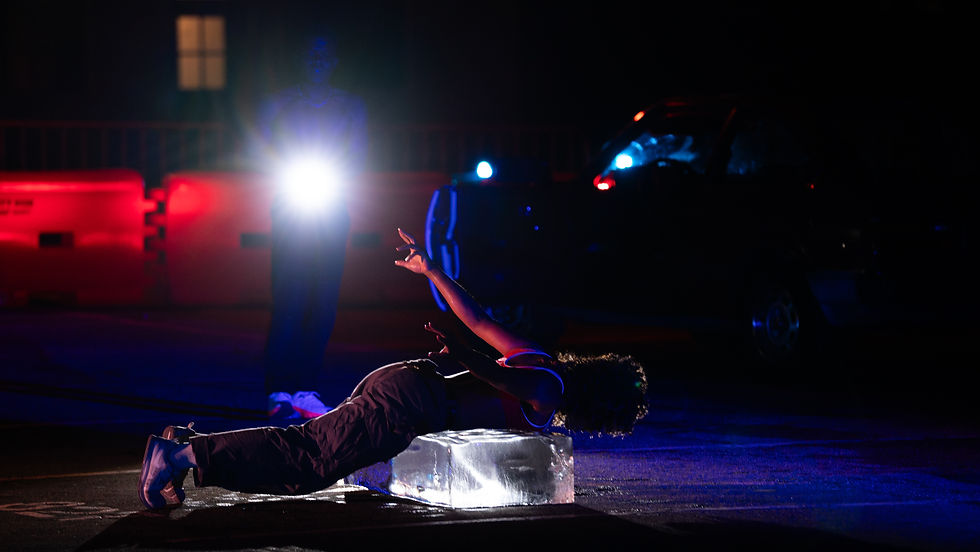
And then, in a moment of true inspiration, jose took off their shirt and laid atop Clarissa’s torso. Hands up, fingers curled down, elbows locked in–Clarissa wrapped her arms around jose, embracing them tightly. The duet was now a trio, with Clarissa sandwiched between the frigid pain of the ice and the warm body of a shivering friend. This image said to me: we must brace not only the pain of our continued circumstance, but the warmth of the friends and lovers around us. Suddenly, almost in spite of myself, I began to cry. I don’t know if a revolution is coming that will overturn this system. I don’t know if we can unmelt the glaciers, free the incarcerated, heal the sick, stop the violence. Maybe the future is just more of this, and more of this again. (“I can’t do this shit no more.”) But in the midst of this, in our exhaustion and our pain, the stinging ice on our backs, we must embrace each other’s warmth.
_________________________________________________________________________________
Jeffrey Gan is a dramaturg, performer, and art nerd based in San Francisco. An arts fundraiser by day, by night Jeff thrives on the daring, omnivorous Bay Area performance scene. He is proud to study and dance with Gamelan Sekar Jaya and Nā Lei Hulu i ka Wēki, and his past collaborations have included work with Detour Productions and Benjamin Akio Kimitch. Jeff’s writing has been published in Hyperallergic Magazine, Situations, Imagining: A Gibney Journal, and Performance Research.

Comments