


Reflection: Johnny Huy Nguyễn's “BURN”
a work-in-progress showing at ODC Theater’s 2026 State of Play Festival

"BURN” is a tribute to fire, not as a source of destruction, but as an opportunity for renewal.
Split wood burns better than logs. Logs are cross-sections of fallen or felled trees, and their bark traps moisture. An axe splits wooden logs along the grain, exposing the rough surface inside, so that the wood becomes dry and easier to ignite.
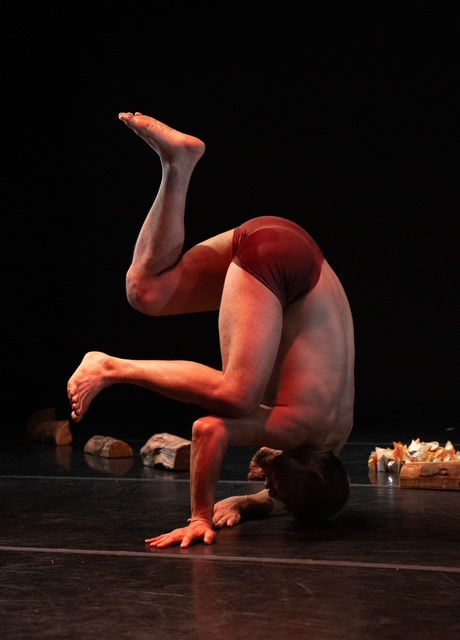
When I decided to attend ODC Theater’s 2026 State of Play Festival, I was immediately drawn to its Curious Creators program because of the festival’s lead photo of “BURN” (pictured above). While this photo does not capture movement, the photo reveals the tension of Johnny Huy Nguyễn’s solo performance, his limbs outstretched with the same color and form as the kindling below him.
“BURN” requires wood that was split by axe. Throughout the performance, a single line of firewood extends in an arc across the width of the stage, dividing the stage in two. At center stage, a pile of firewood waits – each length of wood leaning against another, carefully balanced and ready to burn.
Nguyễn exposes the kindling in the room through his movements and his words. Like the axe to wood, he splits open the space. When “BURN” begins, Nguyễn folds a stack of joss paper into hàng mã, votive paper offerings that are burned as spiritual offerings. He leaves the paper, now folded into the shape of gold and silver ingots, next to the pile of firewood. The paper now tinder, just needing a spark.

Kindling can be more than paper or wood. Nguyễn acknowledges the burning of land and people. He speaks about the Indigenous practices of controlled cultural burning to promote healthier natural ecosystems, and he cites the years and incidents of self-immolation, the act of setting one’s own body on fire. Nguyễn’s performance verges on becoming a lecture. However, rather than scolding me for not knowing or valuing this history, Nguyễn speaks about his own family, his own connection to fire, his own need for renewal and redemption. Because of this vulnerability, the list of facts becomes personal rather than pedantic.
Nguyễn could have easily shown photos of self-immolation in the video projections for “BURN.” His monologue even mentions the photos of Thích Quảng Đưc, the Vietnamese Buddhist monk who lit himself on fire to protest anti-Buddhist discrimination by the U.S.-backed South Vietnamese government. But a photo would create distance, and Nguyễn wants me to reflect on these burnings, not to glorify or idealize them. Instead of photos, Nguyễn puts his own body on display. He removes each piece of outer clothing. He carefully and gently places his pants on the ground and then his shirt on the ground. Then he embodies self-immolation through floorwork, an excruciating series of positions on the ground, balancing on a single limb, the side of his face, a forearm, a foot. I don’t witness the burning, but I witness struggle. I witness his sacrifice of comfort. He slowly shifts from one position to the next, pushing his body until his muscles shake. While there are moments of stillness, there is no rest or relief.
Nguyễn wants me to also engage in self-reflection and discomfort. Nguyễn wants me to shift from witness to participant. So in the midst of the performance, the house lights come up, and Nguyễn breaks the fourth wall. He addresses the audience directly, singling out one guest and asking her name. Nguyễn then asks her three questions:
“Where are you from?”
”Where are you really from?”
“Where are you really, really, really from?”
She quickly answers the first question, but takes long pauses before answering the following two. Nguyễn’s history and identity are part of “BURN,” and he has been asking himself these same questions. He is seeking fire not to obliterate tragedies and traumas of his past, but as part of his way forward. Since the lights are on, I am on display, just like him. I become aware that my body is in this space, this room, this seat. I am no longer watching the performance, I am in the performance. I am part of the kindling, and I am nervous that Nguyễn might call on me next.
“BURN” ends with Nguyễn falling into the pile of firewood, still at center stage. He places pieces of the split wood on himself, then lies motionless amid this makeshift pyre. This stillness is unsettling. I’m worried that there might actually be a spark, that this whole theater filled with kindling is ready to be set ablaze. And when all the lights turn to black, I wonder if the room might now be filled with ash, ready to start anew.
_________________________________________________________________________________
Johnny Huy Nguyễn is an award-winning Vietnamese multidisciplinary dancer, choreographer, performance maker and son of refugees working at the intersection of street and contemporary dance, martial arts, theater, poetry, installation, ritual, and multimedia. His work centers AAPI and global majority communities, creating performances that are equal parts visceral and revelatory, humorous and heartbreaking, all while interrogating the social, political, and cultural forces that shape us. He has been recognized as a Walter & Elise Haas Creative Power Award Finalist, United States of Asian America Festival Featured Artist, and Isadora Duncan Dance Award recipient.
To learn more about Nguyễn and the upcoming “BURN” world premiere, sign up for his newsletter at www.johnnyhuynguyen.com or follow him on instagram at johnny.huy.nguyen.
-
ODC Theater hosted this work-in-progress showing of “BURN” on August 30, 2026 as part of their State of Play festival co-curated by ODC Theater Creative Director Chloë L. Zimberg and ODC Theater Resident Curator Zaquia Mahler Salinas. Every year, the State of Play festival presents premieres and works in progress by dance artists from the Bay Area and across the US.
Delphine Lai is a writer, arts administrator, and arts advocate. She founded Del Arts Consulting in 2009, and her clients have included Alonzo King LINES Ballet, Dance/USA, Duniya Dance and Drum Company, Kronos Quartet, RootStock Arts, San Francisco Dance Film Festival, Yerba Buena Gardens Festival, and more. Delphine was a grant writer for ODC/Dance and ODC Theater between 2014 and 2024, and she is the organizational dramaturg for the National Center for Choreography-Akron (NCCAkron).
Comments