


Mere Mortals: Choreographing the Anxiety of AI + The Aesthetics of Collapse in the Bay Area Imagination

When San Francisco Ballet premiered Mere Mortals in January 2024, the production announced itself as an institutional landmark event. Choreographer Aszure Barton’s first full-length commission for the company and the centerpiece of Artistic Director Tamara Rojo’s inaugural season had patrons and non patrons of the ballet anticipating the program. It was subsequently encored both in 2024 and again in 2026 after multiple sold-out performances and has just completed international touring engagements including the Edinburgh International Festival and Sadler Wells, following the company’s withdrawal from a planned appearance at the renamed Kennedy Center.
The scale of a production always matters. And so does the money behind it. In 2024, SF Ballet received a historic $60 million dollar gift intended largely to support new commissions and expand the company’s contemporary ambitions. This was an exciting gift for people who have long desired for the ballet to push the envelope more and to consider a younger, more unconventional audience who may be less steeped in tradition and less inclined to uphold it. I would consider myself a part of this demographic.
Mere Mortals embodies an impressive scale of institutional production with its massive ensemble cast, immersive digital scenography by Hamill Industries, a live electronic-orchestral score by Floating Points performed alongside the SF Ballet Orchestra under Martin West, and extraordinary costume design by Michelle Jank. The production’s visual architecture felt closer to a large-scale tech spectacle than repertory ballet. Shedding the static architectural confines of classical scenography, the performance space metamorphosed into a fluid, algorithmic environment—unspooling, glitching, and constantly recalibrating itself in intimate dialogue with the moving bodies.
Mere Mortals exists within a time and place where artists continue to be displaced by the very technological wealth underwriting many cultural institutions. So, then, the scale of this production also raises difficult questions about arts funding and cultural distribution, specifically within the Bay Area. The ballet’s reflection on artificial intelligence arrives alongside ongoing conversations around the “creative class,” labor precarity, and who receives the resources to imagine the future at monumental scale while smaller artists and organizations struggle to survive. The production somehow beautifully critiques the systems from which it emerges while simultaneously aestheticizing it. This was a gorgeous dance that used the myth of Pandora’s box to speak to the anxieties and unknown of AI… and left many more confusing aspects of the future for us to sit with when the curtain was drawn.
This reflection emerges from embodied knowing produced through years of my own moving, witnessing, and being in relationship with bodies in performance space. Dance scholar Susan Leigh Foster’s writing on embodiment offers a language for understanding the body not simply as an object that communicates meaning, but as a site where knowledge is generated and transmitted. From this perspective, watching Mere Mortals was not an act of passive observation. For me, watching dance is often more than not, a somatic experience where I think about the bodies on stage, my own body in space and how it relates to stories being told. These embodied encounters often hold questions of race, technology, futurity, and visibility. Mere Mortals is no different.
I have now seen the ballet five times — three during its original 2024 run and twice this season, opening night and the Saturday matinee. What continued to reveal itself through repetition is the work’s preoccupation with collectivism, surveillance, emotional isolation, and the unstable boundaries between human and machinic consciousness. As an artist living in San Francisco, this is something I reflect on often, both in my own work and in conversations with my peers and colleagues. Here, I find a familiar, complicated space where I yearn for some knowns and some answers. The ending left the audience with a glimmer of hopefulness; however I remain uncertain. I feel uncertain about the role AI will play on our collective consciousness and ability to think independently and intuitively. I wonder about the role (and perhaps demise) of creativity and critical thinking. How much of the future will center AI? How might the future include bodies of color? Will non-white bodies be centered in these futures?
The principal casting in this last season deeply shaped this season’s performances and my experience of the work. Opening night featured Joseph Walsh as Prometheus, Nikisha Fogo as Pandora, Parker Garrison as Epimetheus, and Wei Wang as Hope. The following matinee featured Cavan Conley as Prometheus, Madeline Woo as Pandora, Justin-Cooper Meeks as Epimetheus, and Mingxuan Wang as Hope.
What became especially compelling across these performances was the way dancers of color carried significant emotional and philosophical weight. As an artist and audience of color, this is something I pay attention to, not just for the sake of representation but I am also interested in how casting shapes narratives, what it communicates to predominantly white audiences and how stories land differently when I see people who challenge the white normative of the ballet. Nikisha Fogo’s Pandora held a profound interiority, and it felt less like a symbolic archetype and more than existential witness. Madeline Woo approached the role differently, with a quieter but equally magnetic vulnerability that emphasized Pandora’s curiosity and emotional solitude. Justin-Cooper Meeks brought an arresting physical sensitivity to Epimetheus, while Wei Wang’s Hope carried an emotional clarity that somehow found its way cutting through the production’s density.
Beyond my lens, from a critical race perspective, these casting choices matter. Futurist narratives, particularly those concerning AI and the evolution of technology, have historically centered whiteness and white maleness whilst marginalizing and/or abstracting racialized and other marginalized bodies. Scholar Ruha Benjamin’s work on race and technology reminds us that technological futures are never created outside of social histories; they are shaped by existing systems of power, visibility, and exclusion. My question \on casting is not just one of “representation” nor is it one of AI or futurity alone. While I am curious whose bodies are imagined as leaders, innovators, creators, and participants in the future, and whose bodies are rendered invisible, decentered or instrumentalized within those narratives, I am also interested in a future where bodies of color exist and are centered. I am deeply interested in and invested in futures that do not center on AI or its white male-ness and ones that hold more complexity and offer us more hope than anxiety.
As a person who lives, dreams and creates in San Francisco, this matters to me greatly. It also feels immediate. Over the past several years, I have watched and heard conversations about artificial intelligence increase dramatically, becoming a major aspect of the cultural and economic life of the Bay Area. I have also noticed how disproportionately those conversations are led by white men, often through narratives of technological progress that can feel uncomfortably optimistic about what AI might make possible while inappropriately giving less attention and thought to the people who it might impact (artists, the working and creative class, cultural workers etc). I rarely encounter people of color, women, queer people, or other historically marginalized communities represented with the same authority within these conversations. And if they are, the contribution is different— often with critical thought, and concern for the arts, humanities, culture, people and the planet. This absence makes the question of who gets imagined as the author of the future feel less abstract.
The casting in the last two performances of Mere Mortals that I attended complicates these questions further, asking not only who gets to inhabit the future, but whether the future itself changes when different bodies are placed at its center. Mere Mortals placed Black and Asian dancers at the emotional center of the world Aszure Barton has built onstage. This is important. Simply, we need to see non-white bodies in ballet, particularly within narratives imagining technological futures. It is also confusing. To me, the result, here, is not merely representational; I find myself wondering what representation alone can transform. Does placing non-white bodies at the center fundamentally shift how futurity is embodied, or are these bodies being asked to inhabit an aesthetic and set of structures that remain largely unchanged? The question feels unresolved to me, and perhaps that uncertainty is part of what the work opens up.
During this performance, I spent time wondering how non-white bodies on stage challenge the normative assumptions made about technological advances, specifically in AI, and whether it matters. ….More specifically, representation matters, yes, but how much does it matter if the ballet is just replicating structures of power that we already know and are familiar with and replacing white bodies in principal roles with non-white bodies? What truly is being represented? And can we know the intention?
What Mere Mortals ultimately staged for me was not just an anxiety around AI, but also the erosion of distinction itself— between human and machine, individuality and collectivity, intimacy and performance, innovation and extraction. In the Bay Area, where technological futurism is simultaneously reshaping both the culture and the conditions of artistic survival, these questions feel particularly immediate. Here, the future is being built and expressed right in front of us. It is exciting, seductive, unsettling, and increasingly difficult to distinguish from the present or the past. We can absolutely have a futurist perspective that includes bodies of color that doesn’t include AI, just as we can hold values of Afro futurism that are inherently more dynamic and complex, and can feature technology, and technology that isn’t AI.
What is beautiful about dance is that the choreography makes these questions embodied, somatic and physical. Rather than explaining anything about AI directly, Mere Mortals lets us watch bodies negotiate synchronization, autonomy, vulnerability, and collectivity through the choreography itself. The conceptual questions begin to move into the body: What does a human body look like inside a future it did not entirely author? And what happens when that body becomes part of something larger than itself? It is here that the specifics of the dance become most revealing.
One of the ballet’s most haunting moments in the dance belongs to Pandora when she stands alone. For what feels like nearly five uninterrupted minutes, she stands by herself in front of large digital projections of what feels like time lapses of landscapes. But the twisty part is that it's not entirely natural landscapes we see. It has a digitized unnatural quality to it and our brains try to fill in the gaps of what we recognize and don’t. Very little happens choreographically but so much happens in the realm of a precarious future. She watches the screen as we watch the screen, and we are all witnessing and experiencing something isolating, confusing, and beautiful together— almost to ask what is happening, is this happening, is this our future, what can we make of it? What do we do? In a production ruled by velocity, strobing light, and overwhelming ensemble movement through power in numbers, this stillness was absolutely beautiful and simultaneously devastating.
The landscapes behind her resembled oceans, forests, clouds — but never fully resolved into recognizable nature. Everything appeared partially rendered, algorithmically mediated, unstable and incomplete. Pandora’s loneliness within this environment feels insurmountable. Not melodramatic, but deeply existential. She appears to be suspended before a future that cannot yet fully materialize, confronting systems far too vast for comprehension. Barton wisely allows the emptiness of the moment to remain empty. And we all waited together.
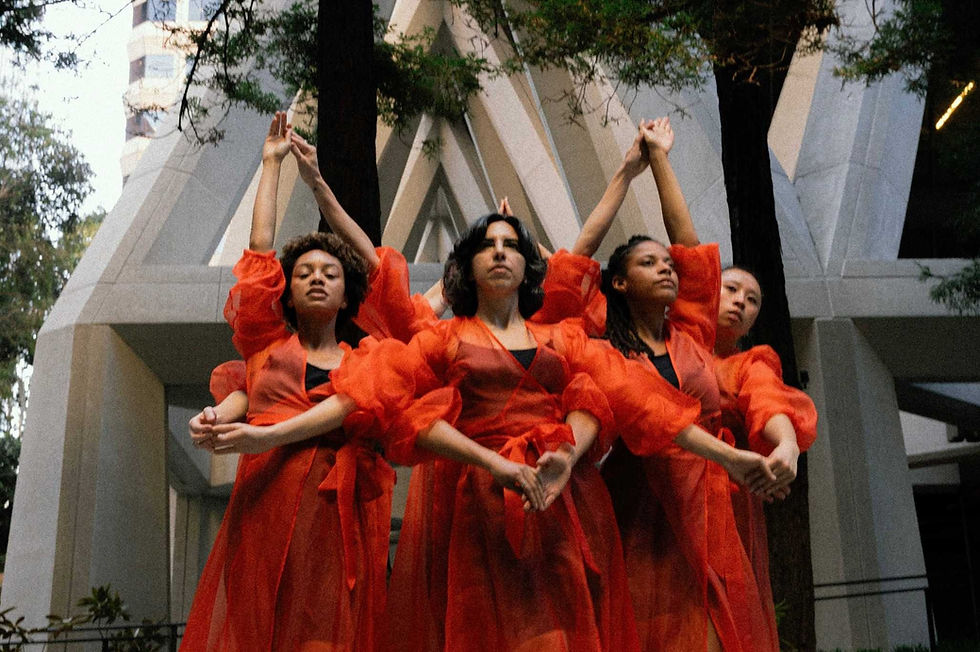
The costumes by Michelle Jank are among the production’s greatest achievements. Shimmering metallic textiles, layering, sculptural draping, and oil-slick surfaces transform the dancers into mythic beings caught between ceremony and simulation. The garments evoke armor, circuitry, ritual vestments, and skin simultaneously. Under Jim French’s lighting, the bodies appear both alternately sacred and machinic.
Meanwhile, Barton’s ensemble choreography remains daunting in its scale. The ballet opens with a blinding strobe before a stampede of dancers surges forward with near-apocalyptic force. Repeated motifs that included side-galloping phrases, arms flung upward, synchronized diagonal formations all created the sensation of bodies absorbed into systems larger than themselves. It felt impending; it also felt foreboding. The ensemble was equally mesmerizing and ominous as if to inquire about whether collective intelligence are both beauty and threat.
Floating Points’ score amplifies this impending atmosphere with pulsing electronic frequencies that accumulate like weather systems or data streams, static that suggest urgency, glitching, ominous, and inevitability. Something catastrophic felt particularly imminent, though the work refused to define precisely what that catastrophe will be. Or when it will be. What lingers afterward are not answers but images as questions: a lone Pandora staring into glitching landscapes, bodies galloping sideways into darkness, gold-clad figures moving in ritual unison beneath an unforgiving electronic sky.
From where I sit, we need to see non-white bodies in ballet, particularly in narratives about technology, intelligence, progress, and the future. And I left the opera house with a few questions still lingering: Does the casting alter what the future means, or does it primarily alter who is visible within it? What, exactly, is being represented—and can we know from the body alone?
These questions are not at all specifically about the dancers or of the work. I absolutely loved Mere Mortals (I saw it five times!) and the dancers were outstanding. These are questions that involve reflection of the relationship between representation and structure. A body can change what we see without necessarily changing the system in which that body has been placed. For me, the most compelling possibility of watching dancers of color in Mere Mortals lies precisely here: they are now simultaneously visible within a vision of the future, while also their presence gives us an opportunity to ask whether the future itself can be imagined differently.
Perhaps that is what I was actually watching the fifth time viewing the work—not simply whether people of color could inhabit the future, but whether the future, through their bodies, could become something other than what had already been imagined.
Mere Mortals had a summer run in the UK at Edinburgh Playhouse August 28-30th and at Sadler Wells, London September 9th-12th.
Benjamin, Ruha. Race After Technology: Abolitionist Tools for the New Jim Code. Cambridge, MA: Polity, 2019.
_________________________________________________________________________________
Nkechi Deanna Njaka (she/her) is a practice-based creative researcher, choreography artist, public speaker and culture writer whose work explores the intersection of embodied presence, somatic research, well-being, science, art, and social practice. She is the founder of The Compass, NDN lifestyle studio, and co-founder of the sleep app DreamWell, emphasizing mindfulness and creativity as essential for individual and global well-being.
Comments