


Radial Rituals | Choreography as Dialogue, Social Architecture and Ecology
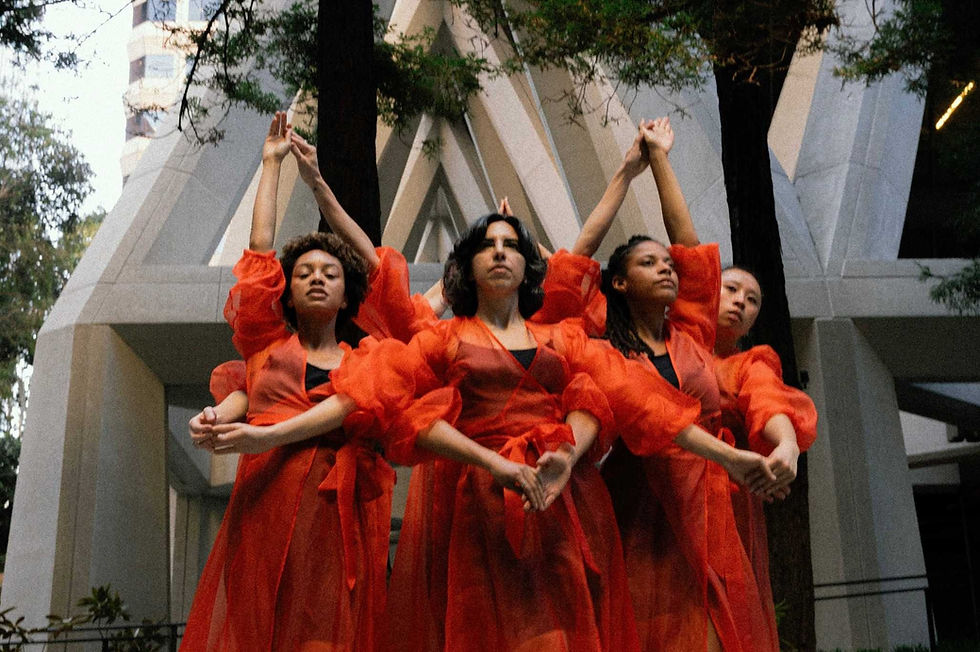
January 15th + 17th, 2026, Radial Ritual was presented at Transamerica Redwood Park in San Francisco, California. Commissioned by the Institute of Contemporary Art San Francisco, this work was choreographed by Madeline Hollander in collaboration with Art at a Time Like This to celebrate the anticipated groundbreaking of Lily Kwong’s EARTHSEED DOME. The work offered the viewers moments to reflect on ritual, the role of technology and our relationship to ecology.
Installed in Transamerica Redwood Park from January through July 2026, the dome marks Kwong’s first major Bay Area installation and one of her most ambitious site-specific/ site-responsive works. Fabricated from seed-impregnated living soil using robotic arm technology developed with Atelio and WASP, the structure grows layer by layer and is embedded with wildflower seeds that bloom over time, transforming the sculpture into a dispersal hub that invites visitors to participate as pollinators and co-stewards of urban ecology.
Raised, as she describes it, “by redwoods,” Kwong’s practice reframes landscape as a cultural language and collective remembering. Her interdisciplinary work spans large-scale ecological installations, public art works, and environmental activism— often centering climate crisis, climate resilience and community engagement. In EARTHSEED DOME, art is clearly a part of the living ecosystem. It is seasonal, participatory, and will bloom over time—blending the boundary between sculpture, architecture, and ecosystem.
Madeline Hollander, similarly, approaches movement as a site of layered systems. From the body responding to the environment, machine rhythm and social architecture, the work felt emblematic of process. Trained in ballet and grounded in cultural anthropology and visual art, her creative practice combines both choreography and research to transform everyday gestures and environmental cues to create unexpected performance structures. Her work has been presented at institutions including the Whitney Museum of American Art and Performa Biennial, and often examines how invisible infrastructures shape collective behavior.
I've known Lily for many years, she grew up with my husband in Marin, and we became close friends when we both moved to LA from NYC in 2020. One of the first things I did was researched the robotic arm company that was going to be producing these bricks— I watched all of the company's youtube demo videos before writing the proposal, and notated its movement, rhythm, pace, and sounds so that they could then be translated into movement once we began rehearsals. I typically show these drawings to the dancers and let them interpret them on their own, and then suture the gestures and movements, created by them, together to form repeating sequences.
—Madeline Hollander, Choreographer
Dance in Dialogue
Radial Ritual was always in conversation with Kwong’s EARTHSEED DOME, this 3D-printed living soil structure weaving ecological and communal imperatives into the heart of San Francisco. The choreography held multiple layers of movement in the space. There were the rhythmic, mechanistic gestures of the 3D-printing arm constructing the dome, the slow process of germinating the redwood seeds, and references to traditional agricultural folk dances. Through this cyclical repetition, the work connected ancient technologies with the obvious emergent ones like the printer, all to reveal connections between soil, machine, body, process and community. The movement structure and the choreography itself layered on top of each other, the dancers moved in uniform and gathered cumulatively. It unfolded in a way that was nonlinear; a clear start wasn’t obvious and a direction of orientation was nonexistent. This is one of the things I love so much about a work that is presented in a nontraditional space.
Non traditional performance space
The site specificity of the performance created a fragmented dynamic within the larger landscape of the exhibition, where multiple activities and encounters were unfolding simultaneously. Radial Ritual moved ceremonially through the redwood grove, in conversation with Lily Kwong’s living architectural vision, which occupied its own designated site within the park. Nearby, the robotic arm and materials offered a visible glimpse into the process that would eventually produce EARTHSEED DOME, making the technology behind the work part of the audience’s experience rather than something concealed backstage.
The dance never went indoors (where the art and installations were) so use of space and where viewers stood to see it was part of the experience. Especially because it took place in the evening, there was a sense that darkness itself was included as choreographic material. We could barely see the dancers (Eloise DeLuca, Nayomi Van Brunt, Katie Gaydos, Natalya Janay Shoaf, Celine Alwyn, and Isabella Soo-Hoo) as they traveled across the very dimly lit grove. Without theatrical lighting and without music, the structure of the work revealed itself through proximity. Paying attention meant you could maybe anticipate where they were going to travel next.
I always enjoy watching how the audience reacts or participates in the work, especially when the piece loops and doesn't have a beginning or ending. The dancers were given a route however it changed each iteration based on the crowds, and they were informed to just flow through open and safe areas, letting the audience have the right away. I find that the pace is really what lets the audience join in or not, and in this case we were moving a bit too fast for the audience to feel comfortable following.
—Madeline Hollander, Choreographer
The performance continuously looped from the future site of EARTHSEED DOME, through the grove to the location of the robotic arm, and back again—a cyclical journey the audience was invited to follow freely, coming and going as they pleased. Performed outdoors at night, in a space that was neither stage nor gallery, the choreography moved between the redwoods and the designated sites of the Transamerica campus, creating a shifting relationship between performer, environment, artwork, technology, and audience. Rather than directing our attention toward a single fixed point, Radial Ritual asked us to navigate the space ourselves, making the act of watching a physical and spatial practice.
I was really excited to receive the invitation from Lily to create a piece that would essentially inaugurate her Earthseed Dome piece, which was just in the nascent stages of its development. There was nothing to see, only imagine, which is the same scenario as when you plant seeds in a garden. Her bricks were in the process of being 3D printed by a Robotic Arm and the site where the dome would be built was empty— surrounded by redwood trees and the circulation of the pedestrians flowing through the site. This set the grounds for Radial Ritual to become a performance that would conjure Lily's "seeds" to grow— the choreography was designed to reflect and mirror the movement of the robotic printing arms, the microscopic movements of a seed germinating (specifically the unfurling of Redwood trees) and also drew inspiration from traditional folk dances and harvesting rituals. We were making visible the invisible dynamics of the site and Lily's vision.
—Madeline Hollander, Choreographer
We were not simply watching the choreography; we were negotiating pacing, spacing, and orientation together, becoming part of the conditions through which the performance could be perceived. Sight and sound worked together to illuminate and obscure the performance: what we could see, what we could hear, and what remained just beyond perception were continually shifting according to where we stood. If you were close enough to see the dancers’ faces, you were close enough to hear them counting softly under their breath. What remained invisible at a distance became audible through proximity. Our own bodies had to either lean in or step aside when we discovered we were too far away or too close, continually adjusting to what the darkness revealed and concealed. In this way, the choreography made the invisible perceptible—not by revealing everything, but by asking us to move toward, away from, and around what could be seen and heard.
I was working with Lily on sound, breath and the idea of the score throughout the process, and she brought in her collaborator, the musician/composer Sandra to lead a breath-work session for us to both explore the connection to vowels in relationship to the piece. She used a harmonium and it was very moving and meditative. We ended up arriving at the idea that the dancers would hum, to try and emulate this harmonium vibration feeling, however in practice this was incredibly exhausting for the dancers since the piece was very cardio-heavy. I opened this up to them to be the authors— letting them count, sing, hum, when needed, to feel free to communicate with each other when needed with their voice, or with gestures outside of the rehearsed choreography.
—Madeline Hollander, Choreographer
Wardrobe + Impact
Costumes were generously provided by Kamperett, the San Francisco–based fashion house founded by Anna Chui and Valerie Santillo. The brand is known for elegant whimsy and sheer silhouettes. In the dark greens and greys of the TransAmerica Park at night, the cherry fire-hydrant red garments illuminated like a signal. Pay attention! And if you weren’t paying attention, or if you were paying attention to something else, a glimpse in the direction of the dancers signalled something urgent and uniform. A collection of red in the dark, mysterious and alluring.
The costumes were magical! They glowed in the dark! and didn't conceal the dancers which I loved. It all came together very coincidentally and uncannily, where Anna Chiu, the founder of Kamparett was [came] to me with an idea at the same moment I [reached out] to her. And then we both realized that we had Lily as a friend in common. Red has always been the color of the sacred for me, and I liked that it was referencing the redwood trees.
—Madeline Hollander, Choreographer
Fashion here moved beyond image into gesture, functioning as a spatial landmark for viewers. Opacity and transparency layered our perception. Bodies were simultaneously revealed and concealed by the redwoods, by the TransAmerica Building and by other individuals yet held within the collective field of red. To see them required effort; to follow them required continuous adjustment.
There was a way in which the voluminous, semi-obscured forms amplified the robotic gestures while extending the physical intent of the dance that was mesmerizing. The shaping of how movement registered in low light was catching to the eye. While the movement was mechanical, rhythmic, robotic and precise, the clothing served as a communicator of direction, relationality, and shared focus.
In Radial Ritual, Hollander utilizes this inquiry to reimagine ritual as a choreography of attention, awareness and social architecture. In the quiet, the dancers’ under-the-breath counting and the shuffling of their feet on concrete became our music. This served as a beautiful reminder that relational movement (what exists between bodies, between humans and landscape and well as what exists between wardrobe and gestures) itself is a soundscape. Our shifting positions became part of the choreography.
Our bodies are constantly performing our social architectures whether we are aware or unaware, our postures, gestures, interactions and bodily vocabulary are molded by the structures and infrastructures that allow us to move through space, like highways and doorways, chairs, and phones of course, and each gesture confirms and strengthens these languages. I love taking these gestures, and breaking them open— this often feels very awkward on the dancer's bodies at first but through repetition it becomes normalized again. We are so quick to adapt to new languages, new architectures and new policies and I hope that my choreographies begin to extract moments from those transformations that we can stop to look at.
—Madeline Hollander, Choreographer
What happens in spaces like this is that we are not simply an audience watching something happen “over there.” We are involved participants in what I understand as social choreography—the invisible shaping of how we inhabit time and space with one another. In the dark, among trees and seed-bearing soil, rhythm, nature, bodies, and technology became collaborators. But this is true, always: we are constantly moving in relation to one another, adjusting, responding, making space, finding our way toward what we can see and hear and what remains obscured. Radial Ritual makes that usually invisible choreography perceptible. It reminds us that how we move through a space is never only our own movement; it is something we make together. Art is not only a part of the social architect, it is also a part of the living ecosystem.
_________________________________________________________________________________
Nkechi Deanna Njaka (she/her) is a practice-based creative researcher, choreography artist, public speaker and culture writer whose work explores the intersection of embodied presence, somatic research, well-being, science, art, and social practice. She is the founder of The Compass, NDN lifestyle studio, and co-founder of the sleep app DreamWell, emphasizing mindfulness and creativity as essential for individual and global well-being.

Comments