


Review: pateldanceworks' "wild light"
- Mar 26
- 4 min read
Through a Prism: pateldanceworks’s wild light by Marlena Gittleman
Time folded in on itself at ODC Theater in December. wild light dreamed forward as it also returned, revisited, and refracted, rather than muscling towards an ending: de-prioritizing teleological spectacle in favor of community practice. Why not, then, compose a response that takes up a similar ethos, one of lingering moments with space to breathe, backwards- and forwards-glancing at the same time?
Part 1 (“for a moment, earthbound”): solo. Part 2 (“ghosts of camille”): quartet. One gesture, first introduced by director Bhumi B Patel and later repeated like a refrain by the four other dancers (Ài Yīn 艾音 Adelski, Maxine Flasher-Düzgüneş, monique jonath, Catalina O’Connor), was particularly memorable for the way it rotated perspective. Bent to straight arm, one hand moves forward in an almost-L shape, another hand moves forward to meet it, thumbs overlapped, to make a triangle. Keeping hands where they are, elbows bend and point out, head moves forward to meet them, so one eye peers through. Torso rotates. A birds-eye view looking simultaneously at you and me and across a horizon and below to the earth.

More perspective play: standing on tiptoes, hinging at the hips and peering over an edge, wings tucked behind. Sensorial disorientation that left me expanded rather than overwhelmed: a trip, in all senses.
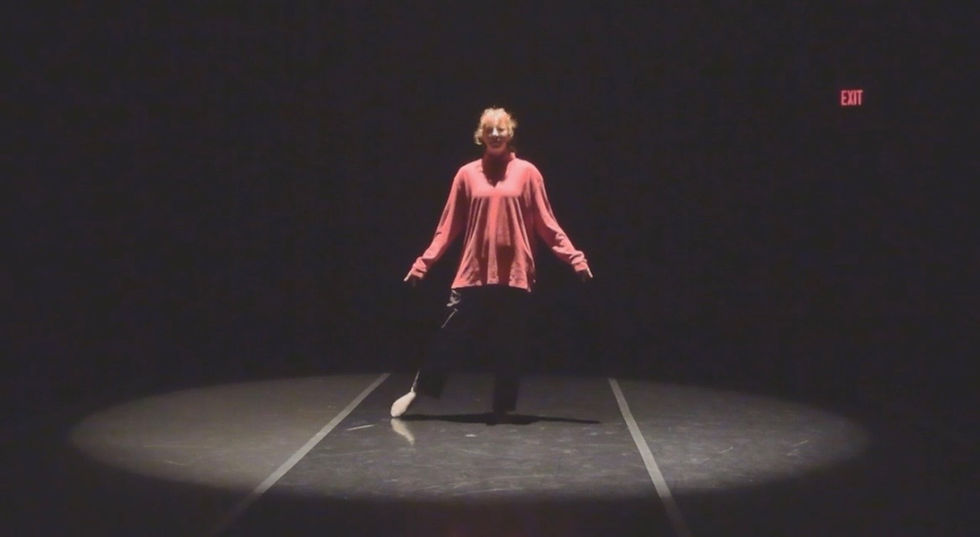
A Lynchian lip synch, a voice coming from sound director Rachel Austin on stage right and silence coming from Patel centerstage, two mouths moving to a refrain of “If I Were a Man.” Patel disavowing the bravura, literally brushing off the traces of misogyny, leaving the forced spotlight: a relief for her and for us.
Between Part 1 and Part 2, Patel, covered in a white textured fabric that resembled sea detritus, lay on the stage. The quartet—embodying Donna J. Haraway’s speculative fiction “The Camille Stories: Children of Compost,” and “land[ing] us four hundred years into the future to imagine beyond the beyond,” per the program notes—moved Patel offstage little by little. They encircled her, looked at each other with intense eye contact, taking their time in silky flowy yellow tops and pants, trailing pieces of fabric off their back that could be tails, antennae, wings, fins, something else that doesn’t have a name yet. Then they started to shift the mass, which also included a horrid blue taffeta gender-oppression sort of dress from the lip synch, traveling by sliding, lunging, squatting, tucking in the fabric, switching places but all the while moving as an organism. It was almost like a magic trick, but slow—no flash, no bang, but at a certain moment Patel and all the accompanying fabrics were no longer onstage.
To allow yourself to be composted offstage after Part 1 says something about your lack of attachment to ego as a director and lack of attachment to human legacy in a piece that spans species, I think.
What to do with a stage empty except for lights? (What would it be like to practice patience, to notice the supposedly inanimate?) What to do with an empty planet? (What would it be like to witness after-the-end?)
A prism. I watched light and gestures reflect and refract. At one point the backdrop scrim got to be this really saturated orange and I thought of the fires that tinted the skies some years ago. Then it became a magenta so beautiful I gasped. Atmospheric respite.
More play: contagious laughter, bumping hips, playing tag, delighting in taking in her face, their face.
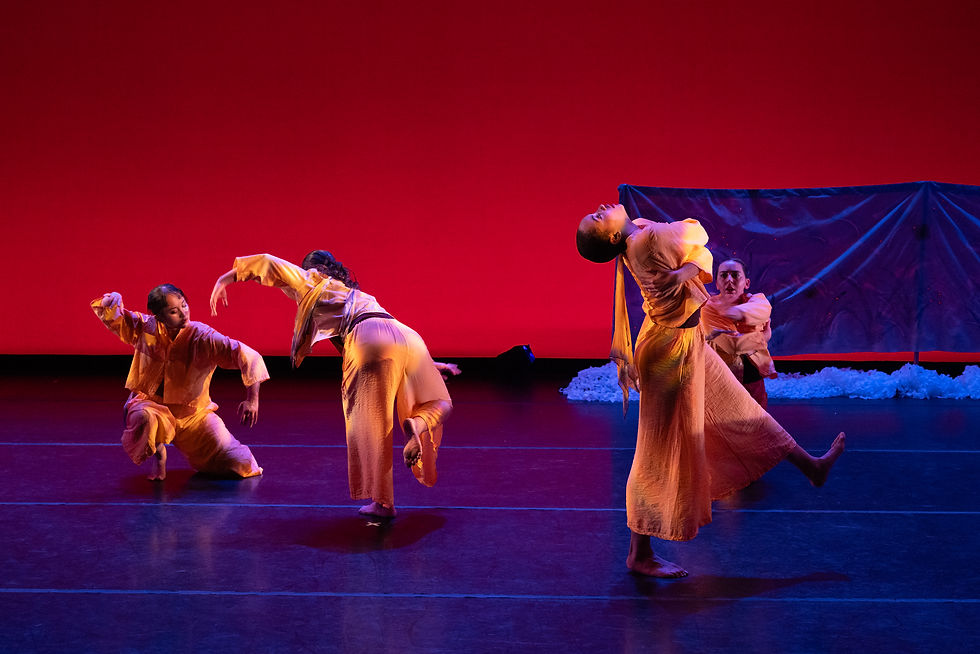
The sense that each dancer in the quartet had their choreography, but that in retrospect their choreography was incomplete without at least one other dancer. A little low ronde de jambe just above the floor that one dancer could and did do alone, but which made more sense on another repetition when the foot was sustained by another dancer’s foot. Or an arm that could be and was raised alone, but which retrospectively was missing its mate until another’s arm came to interlace fingers and raise arms like that. Following Joshua Chambers-Letson following C. Riley Snorton, I felt led towards “future imperfect” syntax¹, which I would re-render here as, “Now, knowing that something was missing, we can see that something was missing before,” or “In five minutes or hours or lightyears from now this gesture will have been completed.”
We’ve all been to performances—and are living in realities—that are profoundly violent and dystopian, that depict or amplify destruction in all its forms. We scroll past them and skim over them. There’s certainly a place for work that alerts us to such destruction. But there’s also work, like wild light, that trusts that we are well aware of the catastrophe and allows us to—however temporarily, at least by our limited capitalist ways of measuring time—inhabit alternatives. The process is queer and decolonial in that it doesn’t set up a binary, though; instead, it’s an opening that’s aware of its surroundings.
Healing, I think, often vibrates on a lower frequency.
See Joshua Chambers-Letson, After the Party: A Manifesto for Queer of Color Life (NYU Press, 2018), 33.
Marlena Gittleman (she/they) is a postdoctoral fellow at the Center for Interdisciplinary Critical Inquiry at UC Berkeley. She completed a PhD in Comparative Literature at UC Berkeley, where she taught writing and literature and researched gestures in US and Latin American queer and feminist literature and performance art. Marlena’s writing has been published in Feminist Studies, In Dance, and Life as a Modern Dancer, and their translations have been published in Critical Times, The Common, and Asymptote. Marlena is a dancer and improviser who has performed in NACHMO SF and with 4Fish x RedEye Productions and Tether Dance Project.


Comments