


Review: Queering Dance Festival
Updated: Apr 13
Queering Dance Festival: Frolic! by Teo Lin-Bianco
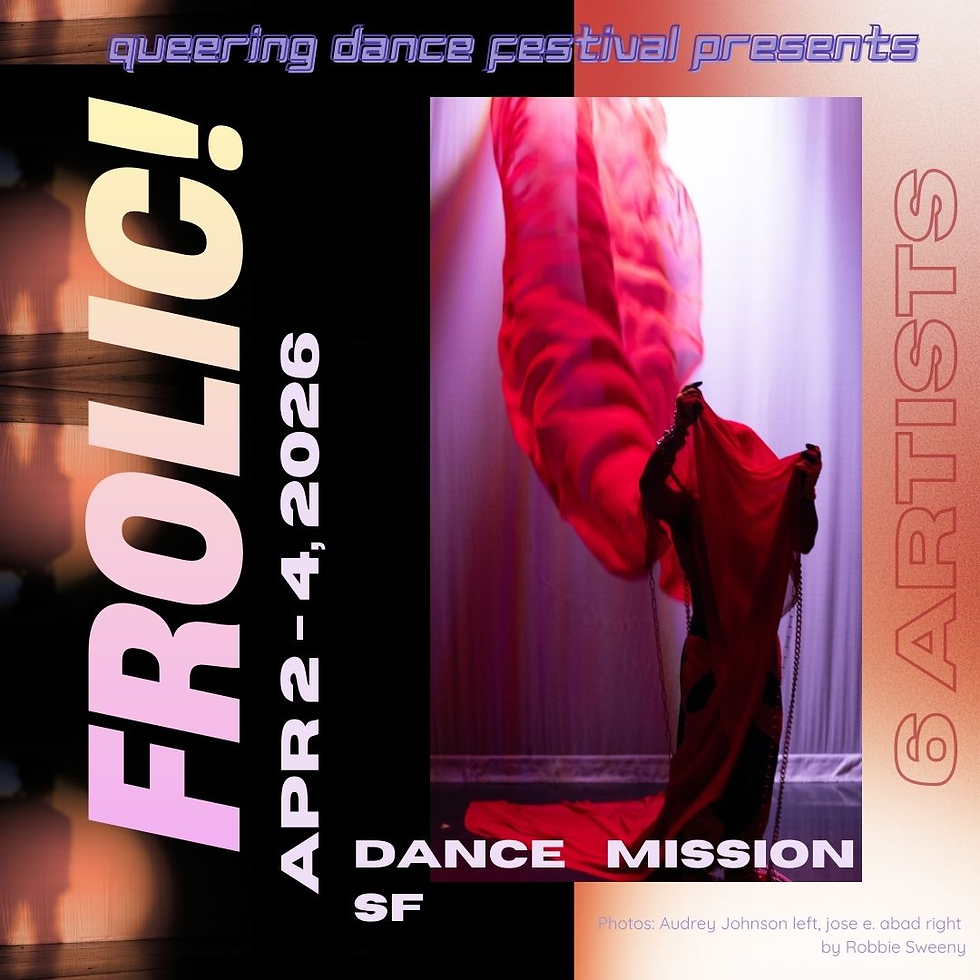
Queering Dance Festival's Frolic! at Dance Mission Theater is as electric as it is thoughtful. From street-style tap to stories of inadvertent sex work, every piece pulls the audience in, hoots and hollers one moment, held breath the next. What emerges across the evening is a portrait of a fundamental duality at the heart of queer life: immense, unrestrained joy alongside a sharp, critical eye toward building a more just world. This is a balance queer people have long known how to hold, forged through generations of hardship and resistance. The bodies on stage carry it with grace, artistry, comedy, and technique.
The show opens with Micah Sallid's We Outside!, a love letter to Oakland. Tower of Power's "What is Hip" sets the stage with its irresistible funk and R&B groove as a soloist launches into what reads as set choreography: clean, deliberate phrases anchored to the music. A second dancer enters, and the piece shifts; the two begin trading off between unison phrases and solo breaks, a call-and-response structure that starts to blur the line between the choreographed and the spontaneous. By the time a third dancer emerges, the stage has fully transformed into something that feels less like a concert piece and more like a battle, each dancer stepping up with phrases that seem to arrive in the moment, daring the others to match them. At one point, a dancer steps off the wooden platform entirely, playing with the physical edges of the performance space and reminding the audience that even the boundaries of the stage are up for negotiation. It is a slam dunk of an opener that leaves you wanting more, which is perhaps the only critique: the wood platform confines the dancers' blocking, making the piece feel a little tight. But this constraint also offers an intimacy that makes the experience feel personal, as though these dancers are at the center of a cypher and the audience is lucky enough to be gathered just at its edge.
In B Dean's Teeth, a masculine-presenting dancer in a full-head mask covered in mirror shards, shakes and writhes on stage as walkie talkie calls from a concerned partner play overhead. The caller, Miss Shark, is trying to reach Beaver Boy. In this post-apocalyptic world of food rations and AI ring cameras, the two have turned to sex work to survive, making Beaver Boy's unresponsiveness all the more alarming. The calls are spliced between dissonant body-horror sounds, reminiscent of Coralie Fargeat's The Substance, and distorted Nicki Minaj songs. The dancer on stage (is it Beaver Boy?) works through fast, acrobatic choreography: throwing themselves to the floor, humping the air again and again, making disturbing transitions between that and coughing a lung out. It is hard to watch. Even for someone comfortable in the uncomfortable, the squelching and screaming coupled with the dancer's anonymity puts you on edge, pulling the whole piece into the territory of a Dennis Cooper novel, where the lines of pain and pleasure blur in the shadow of desperation. Teeth reads as a sharp criticism of queer complacency: in a city where queerness is largely accepted and celebrated, have we grown comfortable while trans, BIPOC, and other marginal communities—those who built so much of this movement—continue to face violence, erasure, and exclusion? Have we passed through the doors of equality and shut them behind us? It is a haunting question, and not a piece I would choose to revisit, but one that will stick with me whether I like it or not.
In Whispers of the Womb, Tajinder Virdee is dressed in what appears to be a salwar kameez as an ornate landline phone sits center stage. The choreography unfolds like a ritual: phrases that never quite resolve, one movement bleeding into the next without pause or punctuation, dragging along the floor one moment, suddenly suspended on relevé the next, the body moving as if caught in a continuous exhale that has no end. Throughout the piece, Virdee slowly disrobes, at one point fashioning their clothes into a baby bump to underscore the central message that "the uterus is the landline of the ancestors" and its ability to foster life is what ties generations together. On the whole, the movement is visually captivating, almost hypnotic in its sustained circularity, and there is real commitment in Virdee's performance. Yet I found myself wondering what the choreography would communicate on its own terms. The voiceover does significant work in grounding the piece thematically, and without it, the movement vocabulary, fluid, continuous, interior, could belong to any number of contemporary works. The specificity of the subject feels located in the text, leaving the body to illustrate rather than embody it.
Nina Haft's Facing Gaza begins with a Passover Seder plate, an offering made in honor of the Jewish holiday celebrated during the time of performance, and dedicated to "all people who are not yet free." As a young dancer begins to eat from the plate, a recorded voice plays, speaking to their father about clashing political beliefs. We learn that the father, now identifying as Israeli, came from a Syrian lineage and is staunchly in favor of Israeli politics. The speaker (presumably the dancer) has arrived at antithetical leanings, and neither will budge. The mutual distrust has carved a rift between them. The dancer moves through acrobatic and fluid phrases while nature sounds play underneath, the body suggesting an attempt to come to terms with something that cannot quite be resolved, a quiet, fraught stalemate. In comes an older dancer, carrying the weight of a motherly figure, and the two move through vignettes of tension and release. There is a great deal of body contact, but it feels like a fight, the stillness between movements underscoring the repetitive, grinding nature of these encounters. The older dancer then breaks into a solo, moving seamlessly in and out of the floor as a "letter to my son in a time of genocide" is spoken aloud. Graceful but guarded, she seems to exist in a permanent state of readiness: braced, protective, never fully at ease. Together, these two dancers feel like opposite sides of the same wound: the child who cannot reach their father, and the mother locked in a perpetual battle to shield her son from atrocity. The result is quietly devastating, a meditation on family, political fracture, and the agonizing question of how far values can diverge before love alone is no longer enough to hold two people together.
Wailana Simcock's Full Release continues the evening's text-based thread. A masseuse, played by Gabriele Christian, emerges from a folded massage table in nothing but shorts, sets up a massage scene, and delivers a monologue about how sex work sort of fell into their lap: the highs, the lows, no detail spared. A client, a "regular joe," arrives and shares an aside that he knows he shouldn't lie to his wife but just “can't stop thinking about cock.” Whether he is queer, curious, or somewhere in the messy middle, the piece doesn't say, and that ambiguity feels intentional. What is clear is that compulsory heterosexuality has done its work on him, and he has arrived, sheepishly, at the doorstep of a queer expert of sorts who might have answers, or at least permission to sit with the question. What unfolds between the two is initially awkward, boundaries unclarified, Regular Joe repeatedly asking "Is this okay?" as they shift through intimate poses. But as the massage progresses the environment softens, and we watch Regular Joe slowly surrender while the masseuse revels in their mastery of the male body. After all, "you don't want them to cum too soon, or too late." 15 minutes, we learn, is the sweet spot. As the climax approaches, Perfume Genius’ "Queen" plays and the masseuse launches into a drag-like lip sync with Regular Joe as their unwitting assistant, reframing the massage as an act of power and self-determination.
Watching Regular Joe unravel, I couldn't help but think of Ocean Vuong's observation that “a man in climax [is] the closest thing to surrender.” By the end, his release feels like a communal celebration, something long anticipated and immensely satisfying. Christian's performance is comedic and thought-provoking in equal measure, and at over 20 minutes, the piece never feels long. It feels like storytime, and whatever story Simcock is telling, I'm listening.
The show closes with Rebound by Saharla Vesh (AKA Major Hammy) and Garrett Lukas Dellios (AKA Beef Cakes). In this bedazzled drag performance, the name of the game is celebration. Through commercial pop, jazz, and hip hop choreography, the two deliver an over-the-top performance that is everything and, most importantly, fun. By the end, they spill into the audience and invite everyone to join the party, because for Major Hammy and Beef Cakes, queer joy is meant to be shared and experienced communally. When they cross the threshold of the stage and dissolve the boundary between performer and witness, the piece becomes something more than a number, it becomes a proposition. In a cultural moment when drag is being legislated out of public life, their movement into the audience reads as quietly radical: an argument made not in words but in bodies, that the antidote to erasure is presence, and that presence is most powerful when it is plural. The fourth wall doesn't just break, it opens, and what floods through is an insistence that queer space can be made anywhere, even here, even now, even together. The audience is having a great time, but not nearly as much as the two of them as they throw ass and take names.
Frolic! is a testament to the range and depth of queer artistic expression. From the Oakland love letter of We Outside! to the dystopian unease of Teeth to the communal euphoria of Rebound, the evening holds space for the full spectrum of queer experience without flattening any of it. It is joyful and critical, intimate and expansive, funny and genuinely hard to watch, sometimes all within the same piece.
There is a Dan Savage quote, perhaps overused in queer circles at this point, that nonetheless keeps finding its way back to relevance: "We buried our friends in the morning, we protested in the afternoon, and we danced all night, and it was the dance that kept us in the fight." Savage said this in the peak of the AIDS crisis; the quote has outlasted the moment that produced it because the conditions it describes have never fully gone away, and in recent years have found grim new expressions. In the United States, hundreds of anti-drag and anti-trans bills have been introduced or passed at the state level, criminalizing performance, restricting gender-affirming care, and effectively legislating queer and trans people out of public life. The message from certain corridors of power has been consistent: you are not welcome here, you are not safe here, you do not belong. Into that context, Frolic! does not arrive as a distraction, it arrives as a rebuttal. The performances here are not escapism or performance for its own sake. They are an act of survival and community, a reminder that queer joy and queer critique are not in opposition but are in fact the same gesture. The bodies on stage at Dance Mission Theater know this instinctively, and for one evening, they made sure the audience did too.
Teo Lin-Bianco is a queer dance artist and writer based in San Francisco. They studied dance and performance at UC Berkeley, where their choreographic and academic work began to intertwine. Currently, they serve as co-director of Tether Dance Project, a company committed to interdisciplinary collaboration and embodied storytelling. With a background in circus, gymnastics, and modern dance, Teo brings an intuitive and critical eye to their writing. They are particularly interested in how movement can act as emotional language, cultural archive, and collective memory.


Comments