


An Interview with Abigail Hinson About Solo 2
by Teo Lin-Bianco
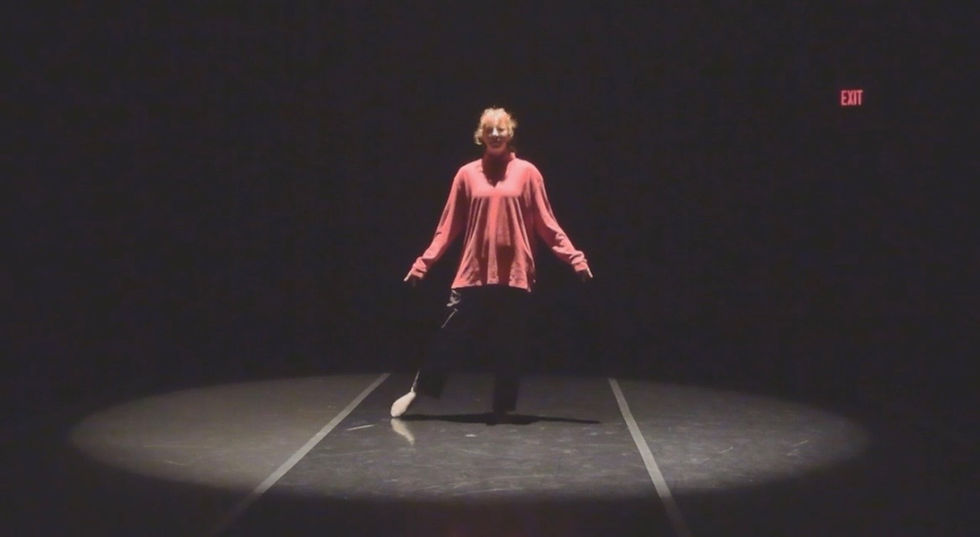
Solo 2, the second installment of the showcase spotlighting Bay Area solo artists, featured an untitled work that resists easy summary.
A woman walks onto a darkened stage, singing,
I go out walkin' after midnight
Out in the moonlight
Just like we used to do, I'm always walkin'
After midnight, searchin' for you (wa-wa-walking, wa-wa-walking)
her voice caught somewhere between hope and heartbreak. It's unclear whether she's aware she's singing at all, or whether the melody is just muscle memory, the sound a body makes while it wanders.
She reaches the far corner of the space and stops, struck by her own shadow. Something like recognition, or confusion. A silent exchange passes between her and this second self before she turns to face us, ties back her hair, and breaks into a run.
She doesn't get far. Each sprinting stride only carries her a few inches forward. It looks exhausting, a body working hard to go anywhere.
By the end, she's downstage, light full on her face. She tells us she has come from "over there" and arrived "here." Some people think it's worse over there, she says. Some think otherwise.
She produces a book titled Relationships and begins to read us a chapter. But the story is cut short, a sudden closure that marks a kind of finality, and a circle of light appears center stage.
She circles it, occasionally letting out monkey calls and other animal sounds, until it's unclear whether she is the spectacle, or whether something invisible inside that circle is.
Lights fade.
As Bay Area freelance dancers, my path with Abigail has crossed time and again. Abigail was a featured choreographer in my dance company’s most recent showcase and we have since spent time together in and out of classes and gigs. After seeing her performance, I asked if she would be open to sit down and talk about the piece together. The following interview has been edited for length and clarity.
Teo: My first question for you is: As a choreographer, I think a lot about titles, and your piece either has no title or is called “No Title”. Can you touch on that a little bit?
Abigail: I wish I had a title. Maybe this is revealing a little bit too much about how I work, but I can only make in the present. In the process of making a piece, I don't really know what that piece is until it's made. To title it before it happens feels really difficult and premature. As a soloist, I'm showing you myself; it has to be something that's right now and real.
Teo: It’s funny, one of the first things that I make is the title. Titles for me are kind of like a guide. They pop up early in my process because they're part of what I strive towards. But it sounds like you’re focused on the process itself, and wherever you end up is just where you end up.
Abigail: It would be different if I was working with a cast, but with solos, I'm searching for an idea. I'm searching for the “why” before anything else. 90% of my solo is thinking, it’s so mental for me. My dance practice is carried easily into the performance itself. It was 100% improvised. I think every solo I've ever done in my entire life has been improvised. I don't know if I've ever choreographed something on myself. I just have to have the idea.
Teo: When you were offered the opportunity to perform did you get into this studio and then it came to you or?
Abigail: Not once. I booked no studio.
Teo: Wow.
Abigail: I went into it, no mirror. I am embarrassed to admit this, that I'm a dancer making a dance piece and I didn't dance at all. This one specifically felt like a performance, and I wanted to do things outside of being in movement. And so I wrote down a list of the things that I wanted to do in this piece. I'm sitting down at the table with [my roommates] and I'm like, “Solo is coming. What should I do?” I wish I could read you off this list. It was like sing, talk, read a poem, dance, make animal noise. And then I just did them.
Teo: You start in darkness with a song. I had no idea you were a vocalist. Did you write that song? Was that improvised?
Abigail: It's Patsy Cline’s “Walking After Midnight”. It's an old time-y tune that resonated with the work, kind of a somber love story of sorts. She’s walking at night, looking for someone, but they've already separated, and she's hoping that that person is maybe looking for her, too, and that they'll maybe find each other. But it's covered in this cutesy twang. It could be sad. It could be hopeful. It felt kind of ambiguous in the message that it was sending. I feel like that gave me more freedom as a vocalist to tone what was really coming across with my body. I think that the elements outside of the lyrics itself helped to build context, for me and my world.
Teo: When you were coming on stage, one of my first thoughts was that it felt like there was something else happening in your brain, and the song was just a byproduct of it. I think ambiguous is a really good word to explain it. I found myself trying to dig into your intonation and the lyrics. I was thinking, “This could mean a million things,” and I love the way that it set the tone for the piece.
I am always interested in dancers that use text, especially when it's spoken. There's a lot of speaking in your piece. What is your relationship with words or text?
Abigail: This is the first dance piece of my own, where I have sung. That was actually terrifying. Text felt similar and a lot easier. I was reading this book and I kind of pulled the theme that made the piece from this book. But after doing it at dress rehearsal I was like, that's way too much. They don't need to know all that. Why am I reading? What are all these words? What am I saying? And then, I chose to just take it all out. Between dress and opening I was like, I don't think I'm gonna do it.
Teo: I'm nervous to speak on stage too. I feel like as a dancer, the voice is just untrained. I am trying to develop my relationship with text, but it's always on screen because I feel like it removes my diligence of having to perform it in some sort of way. But you have a really beautiful section of your piece, which is by far the most resonant for me. After you finish running across the corner of the stage, and you find out that one side is “better” than the other, I felt in that moment a supreme sense of clarity about what the piece was “about” (whatever that means). I felt like you were speaking in a different language, and I was actually understanding it.
Abigail: I first have to say something about you and the untrained voice. Our voices are highly trained. We talk every day. Every single day. What is untrained is the ability to talk like that in front of people. I think the biggest challenge in speaking is actually just relaxing and showing yourself. And that section, I was really just thinking about the essentials: what I needed, what I wanted people to know about what was happening. Essentials are: over there there's this thing, and here's what people think about it; now when I get over here, there's this other thing. Again, going back to this ambiguous ambiguity that I like to play with, I don't like being spoon fed a message or given the answer to all things, which I think some works do really well. What I'm interested in is not knowing, and being curious. Like you said, the greatest thing about art is that it makes us question what we do know; it ignites a lean in. The text that I chose felt like padding the circle: I don’t know what's in the circle, but I'm creating the edges.
Teo: As a choreographer and as a viewer, I think there is this spectrum from work that is very explicit to work that leans more abstract. I think the most curiosity comes from being right in the middle. When work is too abstract, I don't know where to find footing. When work is very explicit, well, all my questions have been answered. I left your piece with so much to say, so many questions; I was left hungry. I like leaving a piece of art hungry and curious. I think that's exactly what I want to foster when I'm working in my process: how can I get someone interested in what I have to say? I think the answer is saying just enough, but not too much, and you did such a good job of that.
The piece, for me, when it ends, feels very cathartic. Not complete, but cathartic, like, there is a sense of resolve. I'm wondering for you, having performed it a number of times: Do you feel like you have said what you needed to say? Both literally and through art.
Abigail: No. There's always more to say. What is complete? Is there such a thing? This very much so felt like a work-in-progress. Upon talking to several people after the show, they said that they felt like the piece was just beginning. “She stepped out of that light, nobody clapped. We thought that it was gonna keep going and then it just ended.” I felt that for myself, the way that the piece ends, it's not in any resolution. I'm kind of changing between these states.
I think, as a culture, we like to wrap things up with a bow. Everything we consume, likes to have an end, and that puts us at ease. It helps us make sense of things. But in life, in reality, I think most things are not like that; they don't have a clear ending, and there's always a blurred line or question that pulls us into the next phase. So the way it resolved is just, naturally, the only thing that could happen, which is that it kind of just keeps going.
Teo: How are you feeling about your piece overall?
Abigail: In full transparency, I finished the stage, said hi to my friends, and immediately wanted to run away. It felt really vulnerable? And I felt like hiding and like I wasn't proud of my work at all. Now, I think I'm feeling a little bit more neutral about it. That was a vulnerable act, but maybe some people enjoyed getting to know me a little bit more, and I'm trying not to judge myself. That is definitely ongoing, that's a forever thing.
Teo: I saw a quote recently in the vein of “the personal is the profound.” When you make work, what is the balance for you between thinking about what you are trying to say and what the audience is receiving? Personally, I focus a lot in the beginning about what it is that I'm trying to sort through and that the audience is kind of secondary. But I know that a lot of artists focus supremely on making sure that the audience is first, where do you feel like you situated yourself for this piece?
Abigail: It's really tricky, and I love that question; I think about it a lot. It is a hard balance to think about how it's gonna be perceived. To me, if it's not perceived, it's not really successful art. You can have art for you, but if I'm gonna be presenting myself on a stage and showing my work and myself. It can be about me but I want it to be about us. I can make work that's about me and my experience—which it is 1000%—but I wanted to be greater than that. I wanted to be something universal, and so I think about the people a lot. As much as I would want the audience to know all this text that I was going to read, if I did that, then it would become about what I think. And I don't want it to be about what I think. I want it to be about what you think.
Teo: I think you did a very good job of trusting your audience, of giving them tools and letting them build it for themselves. I think that's partly why, when it ended, I couldn't really stop thinking about it. Because I felt not just engaged, but involved. It felt like not just a personal reckoning, but something that was being worked out in tandem with the audience. I think that's beautiful. I hope that you're proud. Congratulations on the performance. Is there anything else you'd like to add on?
Abigail: Well, I just want to say, to what you just said about trusting the audience, I only trust the audience because I trust myself. I think every moment as a performer, I have to believe that what I'm doing is—I don't want to say right—but it is the thing. I am doing this. It's an unfaltering belief that you are committed, and that this idea is gonna come through. I think the audience receives that. They receive because I believe in my idea, then they can believe in an idea. Like, you can't love other people until you love yourself.
I feel really grateful to be an artist. Even though I think it's a bit tormenting to create a solo on yourself—you're like fighting with your ego all the time—at the end of the day, it's what we have to do, because who else is gonna do it?

Teo Lin-Bianco is a queer dance artist and writer based in San Francisco. They studied dance and performance at UC Berkeley, where their choreographic and academic work began to intertwine. Currently, they serve as co-director of Tether Dance Project, a company committed to interdisciplinary collaboration and embodied storytelling. With a background in circus, gymnastics, and modern dance, Teo brings an intuitive and critical eye to their writing. They are particularly interested in how movement can act as emotional language, cultural archive, and collective memory.


Comments