


Sara Ahmed at the Queer Theory Buffet
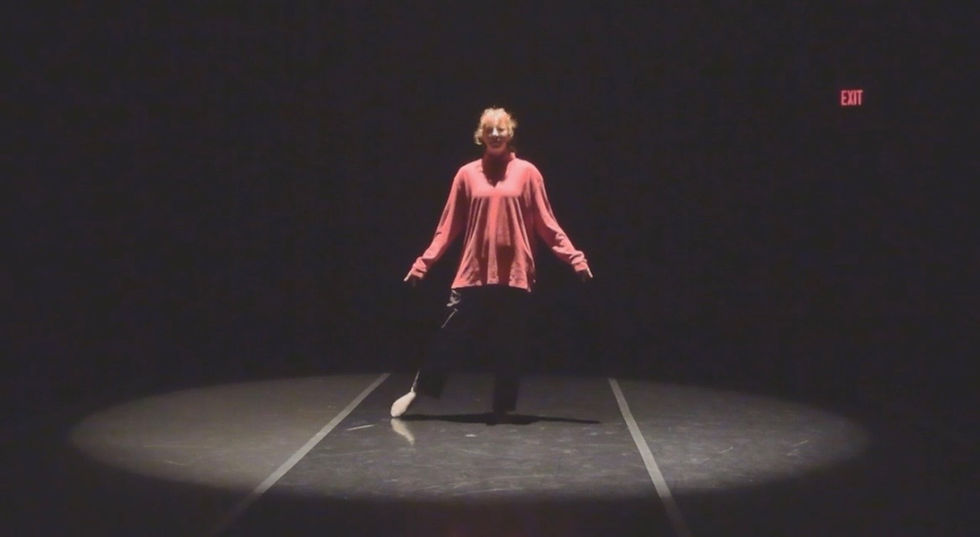
On June 1, 2026, I participated in Hope Mohr's Queer Theory Buffet as part of Keith Hennessey and CIRCOZERO's prefigure during ROT Festival. Four of us—Hope Mohr, Mike Chin, Maria Silk, and myself—selected a queer theorist we wanted to dive into for 5 minutes and provided an embodied prompt to move through the theory. I thought I'd share my buffet offering here!
Sara Ahmed is a British, feminist writer and independent scholar working at the intersection of feminist, queer, and race studies to interrogate how bodies and worlds take shape and how power manifests in everyday life and institutional cultures. She situates herself in the context of lesbian feminism of color, alongside thinkers like Cherie Moraga, Gloria Anzaldua, and Audre Lorde.
Her 2004 book, The Cultural Politics of Emotion, is considered her most foundational text and in it she explores the centrality of emotion to politics, identity, social life, and culture to develop a methodology for reading the emotionality of texts. Since the publication, Ahmed has written a number of field changing books including but not limited to:
Queer Phenomenology: Orientations, Objects, Others (2006) in which she frames queerness as orientation and disorientation to assert that queer phenomenology is a way of conveying relative orientation.
Willful Subjects (2014), in which she frames willfulness as a form of resistance.
Living a Feminist Life (2017), which developed from her blog “feministkillsjoys” and was written as a guide to embody and enact the feminist life every day. My favorite part of this book is her “Killjoy Survival Kit” and “Killjoy Manifesto,” both of which led to her later publication of The Feminist Killjoy Handbook (2023).
And Complaint! (2021) which draws on her experiences and the oral and written testimonies of scholars and students who have made complaints about harassment, bullying, and inequity in higher education to examine the gap between what is supposed to happen when complaints are made and what actually happens.
Until 2016, Ahmed was a professor of Race and Cultural Studies at Goldsmiths, University of London. She ultimately resigned from that position in protest to the failure of the institution to deal with the problem of sexual harassment and violence on campus.
In 2025, she published No Is Not a Lonely Utterance: The Art and Activism of Complaining to unpack the anatomy of a complaint, revealing how institutions stigmatize the act of complaining and complainers in order to silence dissent, and proposes that we might expand our collective capacities to create social bonds through complaint and better environments for work.
We have limited time so I want to go through some of her most central frameworks:
Disorientation: Ahmed’s theorization around the construction of the world suggests that “if the world is made white, then the body-at-home is one that can inhabit whiteness” and that this world made by white bodies is “shaped by histories of colonialism.” So queers of color must employ modalities of queer use and disorientation where queer use is the way that things can be used in ways that were not intended or by those for whom they were not intended and disorientation is the queered space in which “the world no longer appears ‘the right way up.’” Ahmed’s theory suggests that a space of orientation is a home space where one understands one’s position, but queerness requires us to reorient in contact with others to disrupt social relations in hetero-normative contexts. To be disoriented, according to Ahmed, is to make available other ways of being. Instead of a reorientation that takes us the right way up again, we are instead oriented queerly, disoriented queerly, left in the space of imagination.
Citational Policy: in Living a Feminist Life, Ahmed adopted a strict citational policy: she does not cite any white men. She says, “By white men I am referring to an institution.” She does this because this policy “has given [her] more room to attend to those feminists who came before [her].” For Ahmed, “citation is how we acknowledge our debt to those who came before; those who helped us find our way when the way was obscured because we deviated from the paths we were told to follow.” She calls citation “feminist memory” and “bricks: the materials through which, from which, we create our dwellings.”
Willfulness: Rather than a moral failing, Ahmed suggests that it is a political diagnosis used by those in power to punish those who refuse to comply with authority thus making the individual instead of the system the problem. Ahmed reclaims willfulness as a necessary, radical form of resistance. She argues that this persistence and refusal to carry the weight of an unjust system are required to challenge dominant power structures. Willfulness is allowing the “the charge itself to be a connection: a way of relating to others similarly charged. The language can be our lead: if willfulness is an electric current, it can pass through each of us, switching us on. Willfulness can be a spark. We can be lit up by it. We can be lit up by it. And so: we demonstrate; we strike.”
Feminist Killjoy, or killjkoy feminism: she is a figure who disrupts social norms by pointing out sexism, racism, and inequality, often deemed a “spoilsport” for ruining the “happiness” of others. It is a radical, willful, and political stance that exposes uncomfortable truths to challenge damaging structures, turning the act of naming problems into a form of solidarity. In her survival kit are the commitments to ongoing learning, one’s own unique feminist tools, the resource of time, humor, feelings, and other killjoys, among other things. Feminist killjoys are often thought of as downers, but we are not here to make happiness the cause. Feminist killjoys are “willing to snap any bonds, however precious, when those bonds are damaging to myself or to others.”
As a practice, I invite you to find your willful killjoy body. move through the space as a killjoy. Locate your willfulness. Express how the willful killjoy manifests inside you.

I hope to see you at the next Queer Theory Buffet!


Comments